
In December 2025, the Ukrainian Association of Music Events (UAME) completed the third edition of Music Ambassadors Tour, bringing 10 music industry professionals from 9 countries to Ukraine for a four-day journey through Kyiv, northern Ukraine, and de-occupied territories in the south.
The project was created to give international festival directors, bookers, music managers and cultural professionals a direct understanding of how Ukrainian culture continues to function, adapt and rebuild under full-scale war. This year’s edition has now been followed by the release of a documentary film capturing the delegation’s journey and experience. Watch the film here: https://youtu.be/2uql_ywA4Jo
The tour began in Kyiv, where participants were introduced to the contrast that defines daily life in the capital: Christmas lights and public squares standing alongside memorials to fallen defenders, destroyed Russian military equipment, and the constant reality of blackouts and rumbling generators.
From there, the delegation travelled north to Chernihiv, where they visited Fabrychna 12, the cultural space developed by Nata Zhyzhchenko (ONUKA) and Yevhen Filatov (The Maneken). There, participants encountered a model of living cultural continuity: traditional Ukrainian instrument-making being reinterpreted through contemporary artistic practice and digitalized production. At the Peremoha Centre, they saw 3D-printed sopilka and ocarina models based on traditional designs — not as a technological gimmick, but as a practical way to preserve and transmit musical heritage.
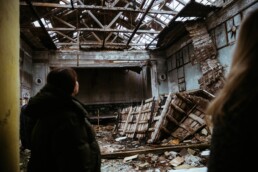
The most difficult part of the route took place in the south of Ukraine, in Kherson and Mykolaiv regions, where the guests visited destroyed arts schools and frontline-affected communities.
In Velyka Oleksandrivka, the arts school building was destroyed by a Russian ballistic missile after de-occupation, having previously been used by Russian forces during the settlement’s occupation. Despite studying remotely, students prepared a small concert for the visitors — a moment many participants described as one of the most powerful experiences of the entire tour.
In Davydiv Brid, a village that was on the frontline in 2022, not a single building remains intact. In Snihurivka, the local arts school continues to operate from an unsafe, inadequate building after losing its original premises. These visits made visible what is often missing from international coverage: the destruction of cultural and educational infrastructure is not only an attack on buildings but also on continuity, identity, and the future of communities.
“Until you come here, you don’t really understand the scale of the destruction, the courage of the people, and how resilient they are. I want to take this experience back with me.” — Pavla Slívová, Head of Booking & Artist Liaison, Colours of Ostrava
“This is a completely different experience from watching it on TV and standing inside a building destroyed by a missile. What struck me most was how people in small towns and villages still come together and somehow keep hope alive.” – Robbie Tolson, Founder, Turn The Tables
The tour concluded in Kyiv with a public event bringing together the international guests and the Ukrainian music community. Discussions focused on the role of music during crisis: as a force for unity, as a response to populism and division, and as a tool for recovery, inclusion and long-term resilience.
Particular attention was given to practical initiatives already working inside Ukraine, including EnterDJ, a project using DJing as a form of emotional support and rehabilitation for veterans and war-affected communities.
“What Russia is doing to theatres, schools and cultural centres has nothing to do with war. It is terrorism.” – Mikko Niemelä, CEO and promoter of Ruisrock Festival, YOUROPE board member
“What shocked me most was how much the world still does not see. I discovered many things I had never heard about before, which means that many of these stories are still not reaching international audiences.” – Ivan Milivojev, Co-founder of EXIT Festival, YOUROPE honorary member, and ESNS Exchange Ambassador
For UAME, the aim of Music Ambassadors Tour is not simply to host international guests in Ukraine, but to create long-term advocates who will carry this experience back to their festivals, institutions, media platforms and professional networks across Europe.
“This tour cannot be reduced to a programme of visits. What matters to us is that people do not simply see Ukraine, but carry this experience back into their own countries, events and professional environments.” – UAME | Music Saves Ukraine.
The newly released documentary film extends that mission beyond the four days of the tour, making the experience visible to wider international audiences.
This project is produced by Ukrainian Association of Music Events with the support of the Askold and Dir Fund as a part of the Strong Civil Society of Ukraine – a Driver towards Reforms and Democracy project, implemented by ISAR Ednannia, funded by Norway and Sweden.
About UAME / Music Saves Ukraine
UAME (Ukrainian Association of Music Events) is a non-governmental organisation founded in 2019 in Kyiv by music industry professionals. The organisation works to develop Ukraine’s live music sector, support artists and cultural initiatives, and strengthen the international presence of Ukrainian music. Since the start of the full-scale invasion in 2022, UAME has expanded its work to focus on cultural resilience, international advocacy, and building long-term partnerships between Ukrainian and European music communities.
Music Saves Ukraine is a charitable initiative launched by UAME on March 1, 2022, in response to the war. It brings together the international music community to support Ukraine through fundraising, cultural projects, and sustainable partnerships.To date, nearly 100 music events across Europe — from industry conferences to major festivals — have supported Music Saves Ukraine. This support has enabled the implementation of humanitarian and cultural projects, the restoration of cultural infrastructure, and the support of music education in frontline and war-affected regions.